Synaps.ing
A single-file, offline notebook that lets you think fast, organize ideas, and stay portable
My desktop's power supply failed, so I'm back on the laptop. Inevitably I often encounter feeling and being disorganized, so I took another run at Obsidian, but as usual I never quite stick with it.
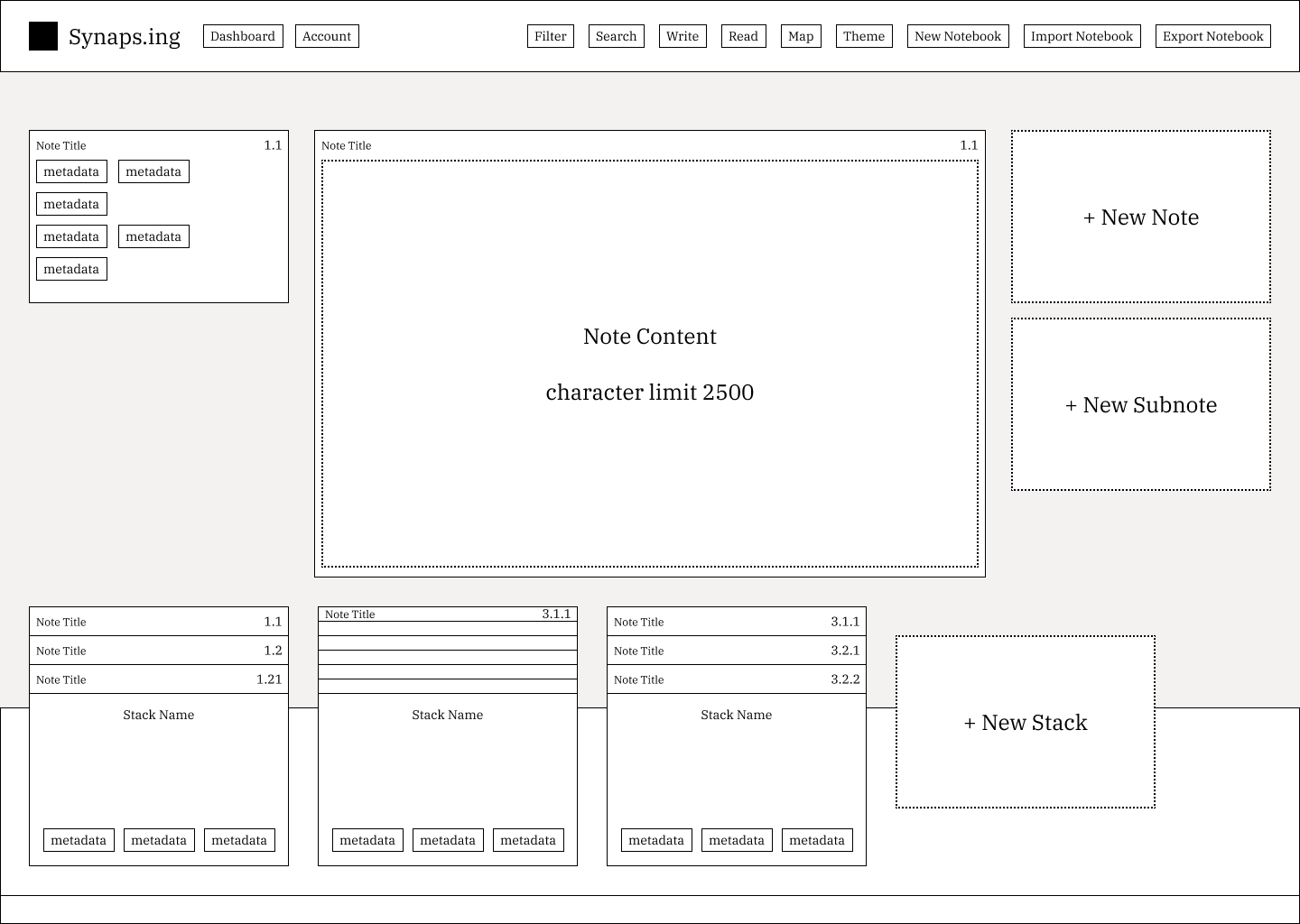
I finally built the thing I've been overthinking for years: a dead-simple memex/Zettelkasten that encourages using the whole workspace instead of burying notes. It's modeled on the original slipbox, reimagined as stacks you can "stack" and order by position in the app, then combine into a single ordered output.
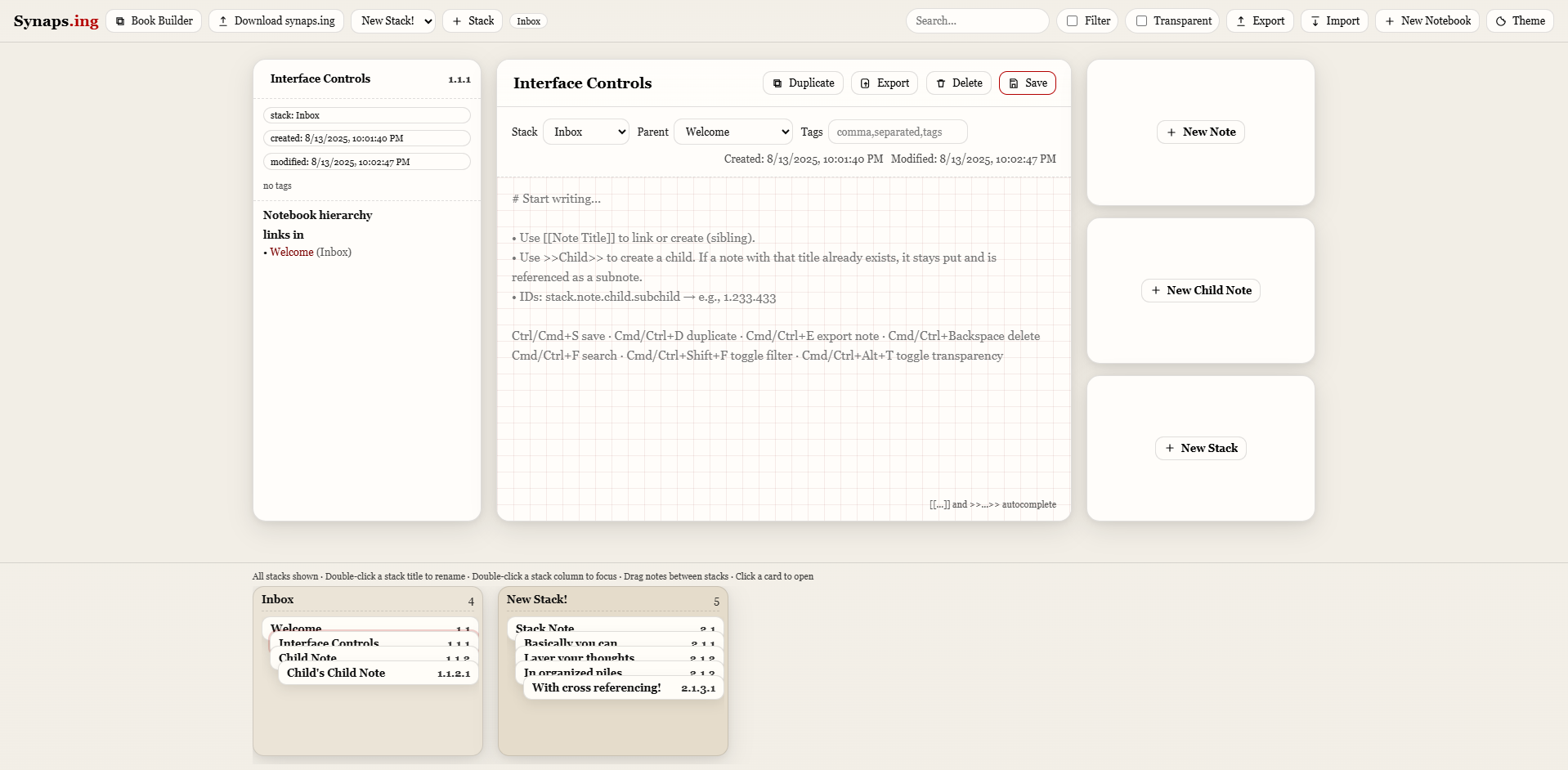
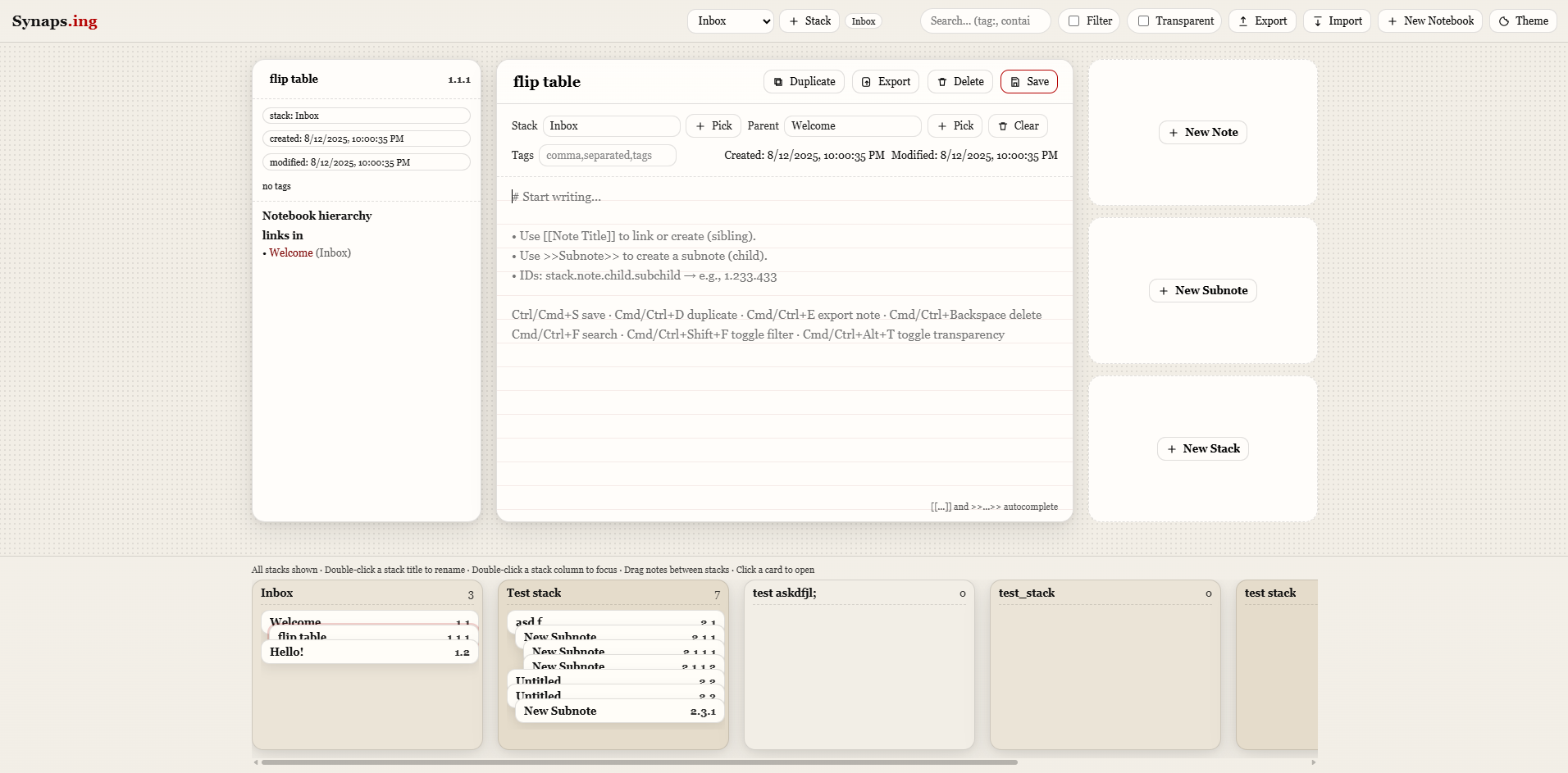
Synaps.ing is a browser-native notebook contained inside a single HTML, CSS, and JavaScript file. It looks a little like parchment and behaves like a desk prepared for ideas.
Notes are written in Markdown and represented with lightweight structured data under the hood. Everything is stored locally. Export and import make backups portable. Notes can be connected with [[note]] links, while >>subnote>> syntax creates lightweight hierarchical relationships.
It is not mobile-friendly. It also has important limitations around browser persistence, large notebooks, and export reliability.
The project is now backlogged... hosted in its original form while I explore a more maintainable web-based successor.
Live Application: https://synaps.ing/
AI-Assisted Development Disclosure
Generative AI, particularly ChatGPT-4o, materially assisted with implementation, debugging, and code generation.
The concept, product structure, visual direction, workflow design, testing decisions, and editorial direction were my own. The code should be understood as AI-assisted development rather than an independently engineered software system.
Core Features
- Single-file, offline-capable notebook
- Linked Markdown notes with cross-stack navigation
- In-place hierarchies for converting notes into parent or subnotes
- Manual save controls with lightweight browser-based autosave support
- JSON and Markdown import and export
- Keyboard-oriented editing and quick commands
- Themes and workspace preferences, including Parchment, Crisp, Lavender, and Moss
- Experimental Book Builder for reordering stacks and compiling notebook content
- Experimental export options for HTML, Markdown, JSON, and browser-generated PDF output
- Link rewriting intended to preserve readable references in compiled exports
- Portable by design: email it to yourself, throw it on a USB, keep moving
Project Media

Project details
Role: Designer, product architect, tester, and AI-assisted developer
Built with: HTML, CSS, JavaScript, and ChatGPT-4o-assisted implementation
Timeline: thinking about it ~4 years; built v1.2 in ~1 week