Early Technical Projects
Early experiments with computers, games, servers, 3D design, and making things.
My first technical projects started well before I could think of them as technical.
Around 2008, following the release of Iron Man, I became deeply compelled to build a suit. I was not a billionaire, so mine was made out of a trash can, air-conditioning ducts, and whatever else I could get my hands on.
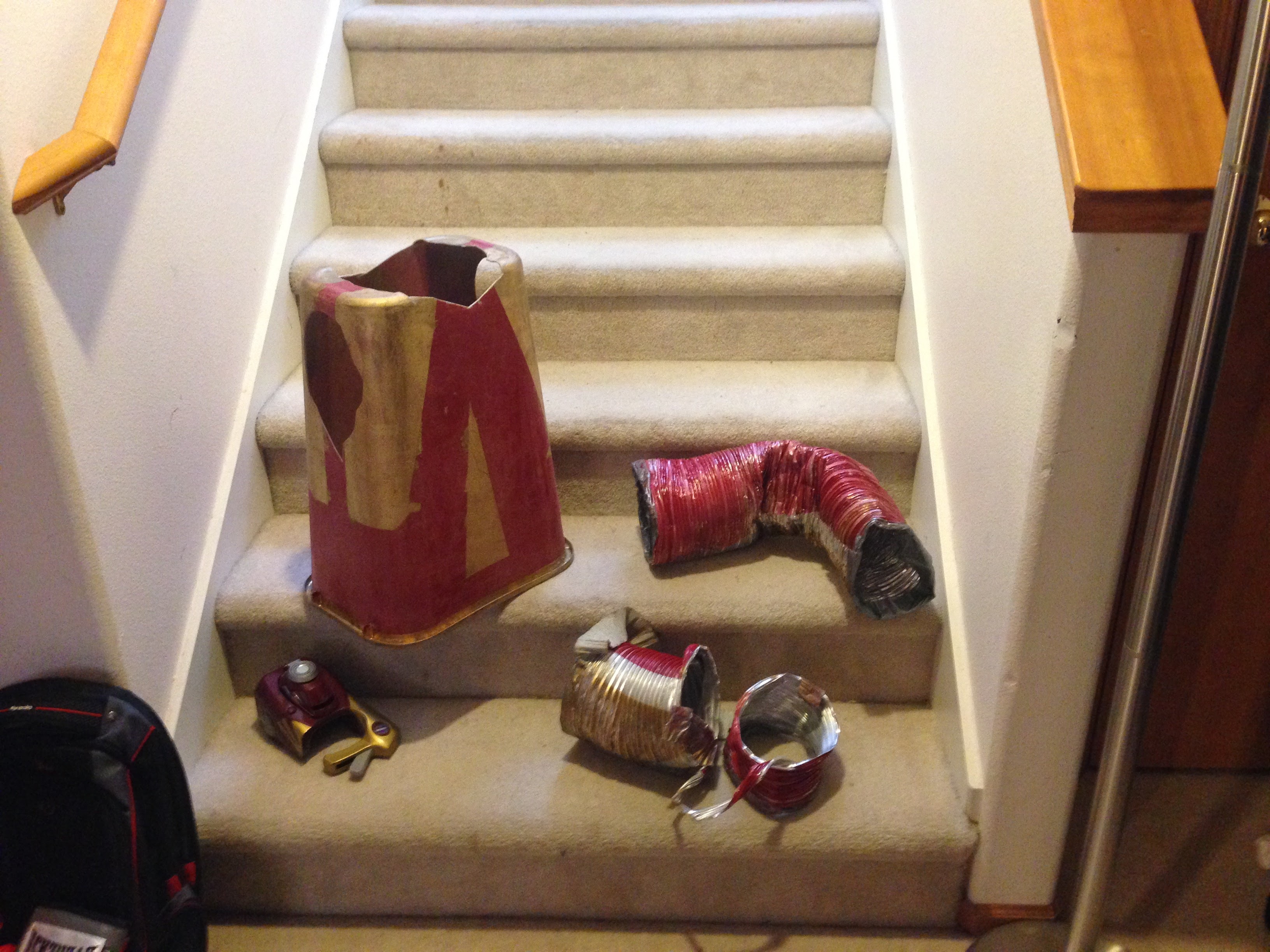
The armor wasn't especially convincing, but the underlying instinct of letting curiosity drive building continued on.
Computers made that much easier.
By the summer before fifth grade, I was hosting a Minecraft server for my friends. Running it introduced me to networking, plugins, mods, configuration files, terminals, and some of my first encounters with code.
Around eleven or twelve, that expanded into game-development experiments with Unity3D and Blender. I built environments, modeled assets, experimented with animation and inverse kinematics, and spent far too much time dreaming up worlds substantially more ambitious in my head than anything that ever made it onto the screen.
By eighth grade, I had started experimenting with CAD using Fusion 360 and attempted a more elaborate MK02 Iron Man suit.
None of these projects were particularly sophisticated, and most never really went anywhere. Their role in developing my skills, however, was significant. They made it normal for me to encounter something I did not understand, find the tools involved, and start building before I necessarily knew what I was doing.
Freshman year of high school, I attempted to build a startup.
The attempt was unsuccessful.
Still, I had assembled a small team, registered a company, and started working toward something we called Investor Connections: a crowdfunding platform for startup investment. The idea was inspired by Regulation Crowdfunding, the SEC rules implementing Title III of the 2012 JOBS Act that began allowing eligible companies to raise capital from a broader range of investors in May 2016.
I knew very little about securities law, startups, or what it would actually take to operate such a platform. In hindsight, the scope was absurd. My distaste for the SEC, however, was valid.
The company failed, but it was my first attempt to organize people around building something intended to exist outside and beyond my own computer.
From there, I moved into a series of small independent and community projects. That work eventually brought me into systems thinking, education, and a much wider network of collaborators.